

Website vs. Sales Funnel — Which One Actually Sells Your Course?

06/04/2026 • 6 min read
Introduction
You've probably been told you need a website. Maybe you already have one. But if you're a course creator or coach trying to sell online, there's a good chance your website isn't doing what you think it is.
The real question isn't "do I have a website?" It's "is my website actually making sales?"
In this post, we're going to break down the key differences between a website and a sales funnel, explain why funnels almost always win when it comes to selling digital products, and help you decide what you really need to grow your online business. If you already have a funnel but it's not working, check out our guide on why your sales funnel is killing your course sales.
What Is a Website?
A website is a collection of pages under one domain. It usually has a homepage, an about page, a blog, a contact page, and maybe a shop or courses page.
Websites are great for brand presence. They help people learn about you, find your content, and research your background. But they're built to give people options — and that's exactly the problem when it comes to selling.
What Is a Sales Funnel?
A sales funnel is a focused, step-by-step path designed to guide someone toward one specific action. Usually, that action is giving you their email, purchasing a product, or booking a call.
Every page in a funnel has one goal. One button. One message. There are no navigation menus, no extra links, no distractions. Just a clear path from point A to point B.
The Key Differences
Purpose
Website: Informs and builds brand awareness
Funnel: Converts visitors into leads or buyers
Structure
Website: Many pages, many paths
Funnel: One path, one goal per page
Navigation
Website: Full menu with links to other pages
Funnel: No menu, no distractions — only a CTA
Conversion Rate
Website: Typically 1 to 3 percent
Funnel: Typically 5 to 15 percent or higher when done well
Turn Traffic Into Paying Clients in 7 Days
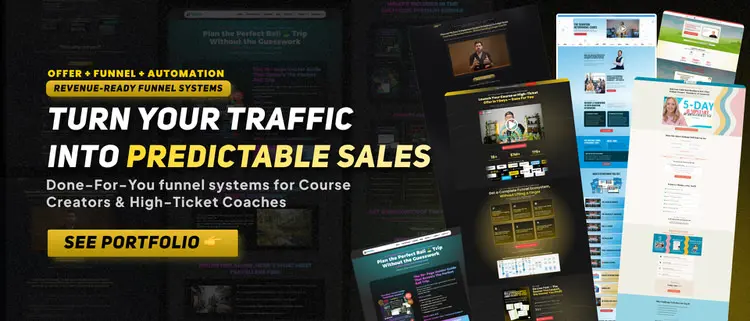
I help course creators and high-ticket coaches install a simple system that turns attention into consistent clients—without launches, manual follow-ups, or guesswork.
Instead of building funnels, we build a Client Acquisition & Conversion System that:
What You Get:
- Conversion-focused system
- High-converting messaging
- Automated follow-up (email + DM)
- Clear path from click → client
Why This Works:
Most people build pages.
I build systems that convert.
That’s how clients go from:
$10K → $20K in 10 days
$400/month → $3K+/month
Why Websites Fail to Sell Courses
Here's what actually happens when someone lands on a typical coach or course creator website. They come in from a social post or Google search. They land on the homepage. They read a little. They click to the about page. Then they browse the blog for a bit. Then they get distracted and leave.
No email captured. No sale made.
This happens because the website gave them too many choices. Every click away from the buy button is a lost opportunity. And most websites are full of those clicks.
The Distraction Problem
When someone has 10 places they can click, they don't know which one to choose. So they often choose none. A funnel removes this problem entirely. There's only one thing to do. That focus is what creates conversions.
Websites Don't Follow Up
A website doesn't collect emails automatically or send follow-up messages. Unless you have a pop-up or form, most visitors leave and you never hear from them again. A funnel is built specifically to capture leads and follow up with them automatically.
Why Funnels Work Better for Course Creators
Here's the thing about selling a course: you're asking people to invest money in something they can't physically touch. That takes trust. And building trust requires a sequence of events — not just a page they visit once.
It Meets People Where They Are
A funnel can start with something free. A guide, a training, a quiz. This pulls people in at no risk and gives them a taste of your value. Then, once they're engaged, the funnel presents the paid offer.
It Sells on Autopilot
Once your funnel is built, it works for you 24/7. Someone can find your lead magnet on a Monday morning, go through your email sequence, and buy your course on Friday — without you doing anything extra.
It Maximizes Every Visitor
With upsells, downsells, and order bumps, a good funnel can earn 2 to 3 times more per customer than a simple sales page. Every step is designed to increase the value of each transaction.
When You Might Need Both
This isn't an either/or situation for everyone. If you're focused on SEO and long-term organic traffic, a website with a blog makes sense. Over time, blog posts can rank on Google and send traffic to your funnel pages.
But here's the key: your website should always lead people into your funnel. Every blog post should have a CTA. Every page should point toward your lead magnet or sales page. Think of it this way: your website is the store window. Your funnel is the checkout counter.
How to Get Started With a Funnel
Step 1: Pick One Offer to Focus On
Choose the one product or program you most want to sell right now. Your funnel will be built around this offer.
Step 2: Create a Lead Magnet
Build a free resource that attracts the same person who would buy your paid offer. Make it specific, valuable, and easy to consume.
Step 3: Set Up Your Opt-In Page
Build a simple page with a headline, a few bullet points, and an email opt-in form. The page should only have one goal: get the visitor to submit their email.
Step 4: Write a Short Email Sequence
Set up 5 to 7 automated emails that go out after someone opts in. These emails should deliver value, build trust, and make an offer for your paid product.
Step 5: Build Your Sales Page
Create a focused sales page with a clear headline, benefits, social proof, and a buy button. No extra links. Just the offer.
FAQ
Do I need to delete my website to build a funnel?
No. You can have both. Use your website for content and brand presence, but make sure every page points visitors toward your funnel.
What is the best funnel builder for course creators?
Popular options include GoHighLevel, ClickFunnels, Kartra, and Kajabi. Each has pros and cons depending on your needs and budget.
How is a funnel different from a landing page?
A landing page is just one page. A funnel is a series of connected pages that work together to move someone through a buying journey.
Conclusion
A website is a great tool. But it's not built to sell. A sales funnel is. Here's what to take away from this post:
- Websites give people too many choices and rarely convert visitors into buyers
- A funnel focuses on one goal per page and creates a clear path to purchase
- Course creators need funnels to build trust, capture leads, and sell on autopilot
- You can use both — just make sure your website points into your funnel
- Start simple: one offer, one lead magnet, one email sequence, one sales page
Stop relying on your website to do a job it was never designed for. Build a funnel, and let it do the selling for you.
Thanks for Reading
Ready to Turn Your Traffic Into Consistent Clients?
If you're done guessing and want a system that actually converts—this is where we start.
I build Done-For-You Client Acquisition & Conversion Systems for course creators, coaches, and digital product businesses—designed to turn attention into predictable clients and revenue.
📺 Learn More on YouTube
Want to see these strategies in action? I break down funnels, content systems, and growth tactics every week.
👉 Subscribe to my YouTube Channel🛠️ Tools I Use & Recommend
These are the exact tools I use to build funnels, grow audiences, and run my business. The links below are affiliate links they cost you nothing extra and help support this content. Thank you! ❤️
All-in-One Business Platform:
▶ Course hosting, marketing automation, and DMs. Everything in one
▶ The step-by-step system for creating and launching your online course.
YouTube Growth Tools
👉 🤖 VidIQ — AI-powered YouTube growth and keyword research.
👉 🔴 TubeBuddy — The go-to research tool for YouTube creators.
Video Editing & Production
👉 🎨 DeHancer — Professional film emulation, grain, and color tools.
Use code "MAIK" for 10% off.
👉 🎶 ARTLIST — Royalty-free music and SFX for your videos.
Join our Newsletter
Get the latest articles, strategies, and tips delivered straight to your inbox.


